
2022 Honda Classic Betting & DFS Preview

Ron Klos

5 years ago

After an entertaining West Coast Swing, the PGA Tour journeys east for the Honda Classic and the start of the Florida Swing. The Champions course at PGA National is a Par-70 ranked as the most difficult annual course on Tour, averaging 1.38 shots over par the last five years.
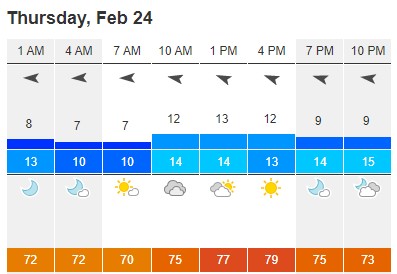
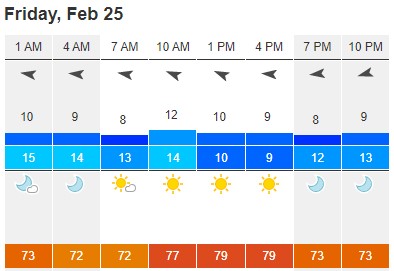
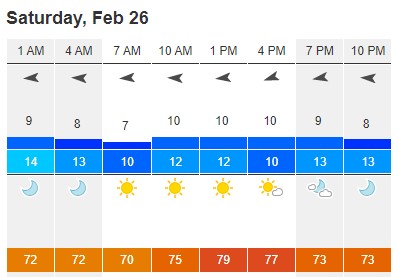
With fewer trees than other parkland courses and only seven miles off the Atlantic coast in Palm Beach Gardens, Florida, PGA National is exposed to gusty conditions as winds often have an effect on this event and make scoring conditions that much more difficult.
The average winning score over the past 12 years has been 9-under par. The winner has either been a favorite or at odds of 300-1 or longer eight times in the past 10 years. Winners that were favorites have included the likes of Justin Thomas and Rory McIlroy, while longshot champions include Keith Mitchell, Padraig Harrington and Michael Thompson. It will favor golfers with a balance of short game and ball-striking who can avoid penalty areas, scramble for pars and manage any windy conditions.
Success here will depend highly upon the player’s ability to navigate the closing stretch of intimidating holes, which is famously known as the “Bear Trap”. The 15th and 17th holes are long par-3s over water, while the 16th is a forced layup to another approach shot over water.
The field for this year’s Honda Classic is set at 144 golfers and is on the weaker side with only five of the top 30 players in the world in attendance. Despite being played in their backyard, many of the top golfers are taking the week off to rest. As is typical, the top 65 and ties make it through the cutline and into the weekend. Some of the pre-tournament favorites include Louis Oosthuizen, Daniel Berger, Sungjae Im, Brooks Koepka, and Tommy Fleetwood.
For more Honda Classic picks, check out Ryan Noonan’s Betting Card.
Jump To: Final Scoring Model | Bets | DFS Strategy & Player Pool
Past Honda Classic Winners/Odds
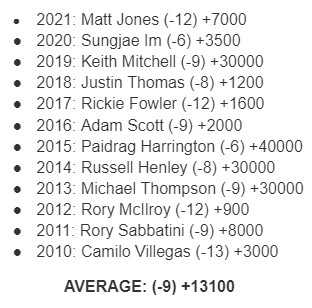
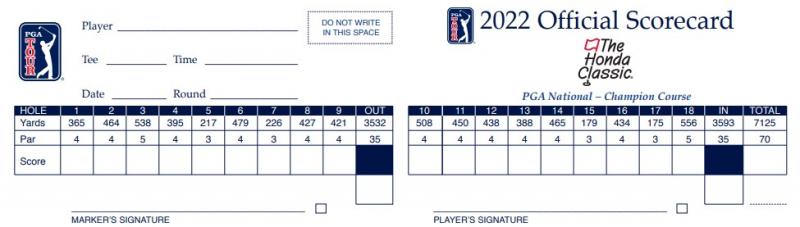
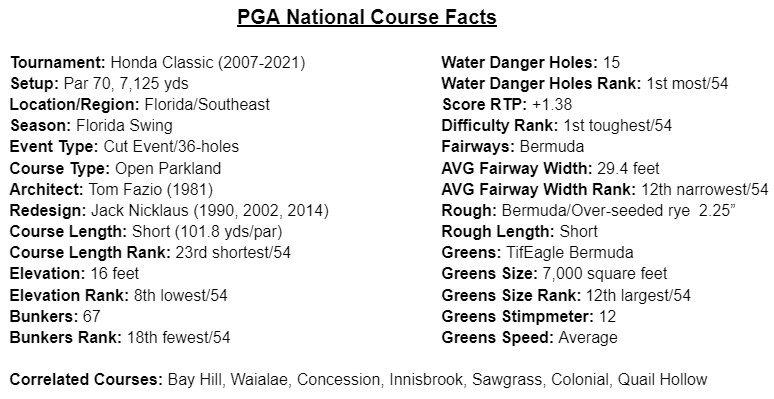
Honda Classic Winning Trends
- 10 of the last 12 winners had at least three previous career wins
- The last 13 winners had played in at least one previous Honda Classic
- 10 of the last 12 winners have finished T17 or better at TPC Sawgrass
- The last 6 winners produced a T16 or better on the West Coast swing
- 9 of the last 12 winners had finished 13th or higher in a previous Honda Classic
- 9 of the last 12 winners had at least one previous top-10 finish that season
Past Player Quotes
*Quotes courtesy of ASAP Sports Transcriptions
Keith Mitchell: This golf course you’ve got to stay so patient. I know a couple of holes out here you don’t even look at a flag. You just hit it in a certain spot on the green, and it doesn’t matter where the flag is, you’ll be all right. That works when you’re hitting it well. A lot of times pars are a good score. I don’t think you can play aggressive out here. If you do, I think it will eat you because this golf course is tough.
Rickie Fowler: I love that it’s a ball-strikers golf course. You’ve got to drive the ball well to give yourself an opportunity to get a ball close on the greens. Yeah, putting can save you, but you’ve got to be solid tee-to-green here. I feel like it brings out some of the guys that are hitting the ball the best that week. I don’t like all the water. I’ve got to try and stay away from that. It’s a good test of golf here. Like I said, you’ve got to be on point tee-to-green. You can’t fake it around here. It’s a good test, and especially when we get the kind of standard 10-to-20-mile-an-hour winds.
Padraig Harrington: On a windy day, if things are going well for you, you do tend to be able to make a few birdies coming home. If you’re a couple over par early on, you don’t see any way out. There’s a lot of tough shots, a lot of tough tee shots. A couple of tee shots that you’re really under pressure to hit the fairway in a strong wind. You just have to man up and hit the shots, that’s it. We are going to hit a few bad ones but you’ve just got to stand there and try to hit the right shot at the right time and accept your fate.
Tommy Fleetwood: The wind is a massive factor all the way around the golf course. I feel like there are so many cross-winds that bring misses off the tee, into the greens, cross-winds affect the putts, and it’s just an all-around very, very difficult test, and it tests everyone. It tests every part of your game.
Brooks Koepka: Obviously if you’re nervous it’ll show up. This golf course, there are about five to seven holes where you can really take advantage of it if you hit the fairway and you’ve got a good number to the flag, and you’ve got to take advantage of those if you want to move up, and the rest of the holes you’re just kind of hanging on and trying to make par, maybe sneaking in one or two birdies.
Aaron Wise: On a golf course like this, I think (the wind) is just something you have to embrace. If you don’t, you’re in for a long day. You’ve got to sort of embrace that and pick your targets and know par is a good score on a lot of these holes.
Denny McCarthy: It’s a place that I’ve always thought has suited my game, playing on the Bermuda grass down here. I like playing in the wind. I think it forces you to be more creative, which is kind of more my style of play.
Jack Nicklaus: It should all be won or lost here. It’s not about length, it’s about precision. It’s about guts. It’s all about what do you have in your chest that you can finish those holes.
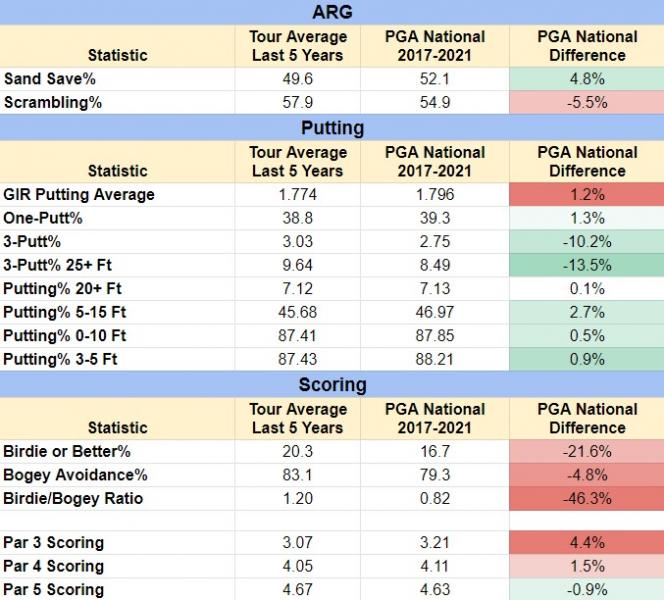
Key Course Stats Compared to Tour Average
*Green = easier
*Red = more difficult
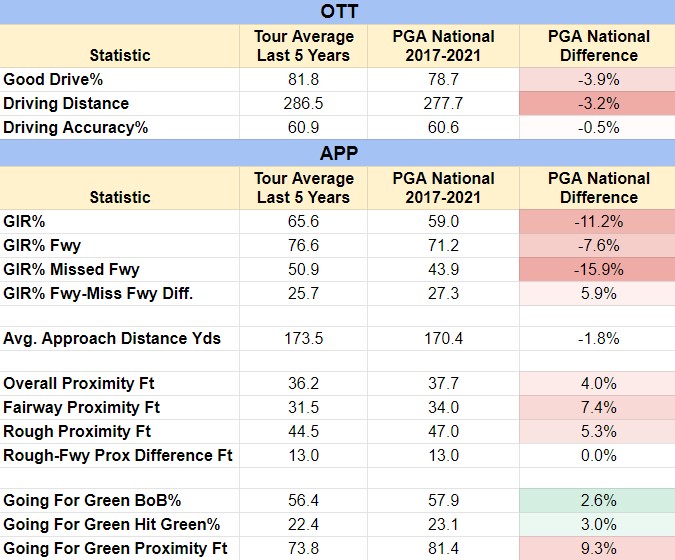
Course Overview
For the 15th straight year, PGA National will host the Honda Classic. The course was originally designed by architect Tom Fazio and re-designed multiple times by the legendary Jack Nicklaus.
While the length seems short by average Tour standards at just 7,125 yards, it is a brute of a course—nine par-4s playing longer than 420 yards. With only two par-5s to score on, there are just four total holes with a scoring average under par here.
Trouble is literally lurking everywhere as strategic bunkers along with 26 actual water hazards on 15 different holes litter the property.
Along with the water hazards, part of the switch to Florida golf is the return of actual Bermuda grass. While the rough is still mostly overseeded rye, fairways and greens are Bermuda. Greens are large at an average of 7,000 square feet and run around 12 on the stimpmeter.
With narrow fairways, 3″ Bermuda rough, 11 out of 14 drives with water danger and potential moderate winds, players at the Honda Classic will have their hands full off the tee. Since danger areas dictate where you can hit the ball, players have to play positional golf on many occasions, which makes the course play longer than its measured. While added distance and accuracy are beneficial, they are not necessary for success. The rough is not as penal, meaning golfers just need to keep the ball in play and away from the water hazards and fairway bunkers. With narrow 30-yard fairways pinched by numerous bunkers along with lakes and ponds everywhere, that is easier said than done. PGA National has had more “water balls” the past three years than any other course on Tour.
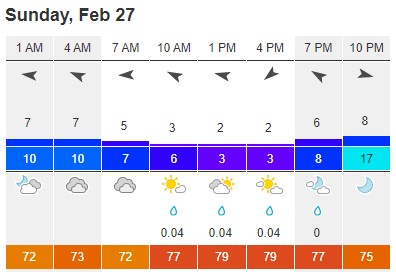
The Greens in Regulation % at PGA National is only 59%, which makes it the third-toughest “GIR” course in the Tour’s annual rotation. About 66% of all approach shots come between 125 and 200 yards. With so many high-pressure approach shots over water, Greens in Regulation % is actually a stat that matters this week. With birdies few and far between, players can actually par their way into contention. Early reports from caddies scouting the course is that the greens are as firm as ever. With winds forecast in the 15-25 MPH range during certain periods, we might need to prepare for a week of carnage.
With all golfers missing greens due to the conditions, players will need to scramble around the greens and bunkers and grind out pars to stay afloat. While the Bermuda green complexes are relatively flat and putting is on the easier side, scrambling is 6% tougher than the Tour average. All in all, every part of a player’s tee-to-green game will be tested.
Top 10 Most Important Stats
*In order of importance.
- GIR %
- Double Bogey/Bogey Avoidance
- Good Drive %
- SG: APP
- Par 4 Scoring
- SG: OTT
- Scrambling
- Proximity 150-200 yds
- SG: Putting (Bermuda)
- SG: Moderate Wind
Unique Tournament Splits
- SG: Florida
- SG: Difficult Scoring Courses
- SG: Water Danger
- SG: Moderate Winds
Palm Beach Gardens, Florida Weather Forecast (February 24-27)
Player Selection
The Honda Classic completes the total transition from the previous “birdie-fests” of the West Coast swing to an event where making more than one birdie per round at PGA National can be viewed as an accomplishment. This transformation is encapsulated by the fact that my “Safety” model is part of the “Core 4” this weight and is the highest weighted split overall.
With “water mines” everywhere on the course, all it takes is a couple poor shots to completely derail a round. Consistent ball-strikers with mid-to-long irons who are not erratic off the tee are paramount in building any lineup or betting card this week. Furthermore, I will be focusing on players who are have a strong record of avoiding, not just bogeys, but double bogeys as well.
With winds forecast to be moderate at times, and always capable of gusting, I have also included SG: Wind in the model this week. This ranking analyzes which players have historically played the best in winds of 15+ MPH.
With trouble lurking, players need to be in control of their swing heading into this event. I will also definitely target players who are in good form with good ball-striking results over the past few weeks.
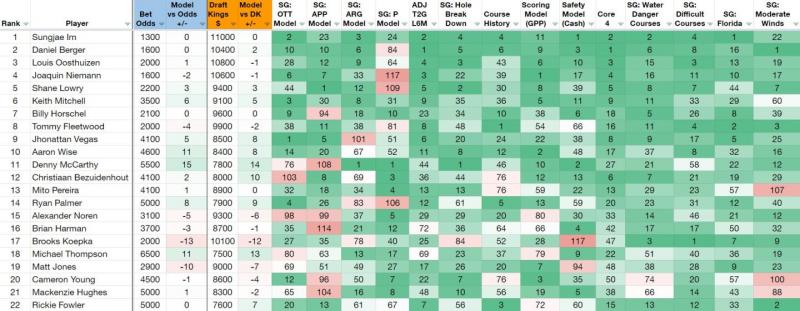
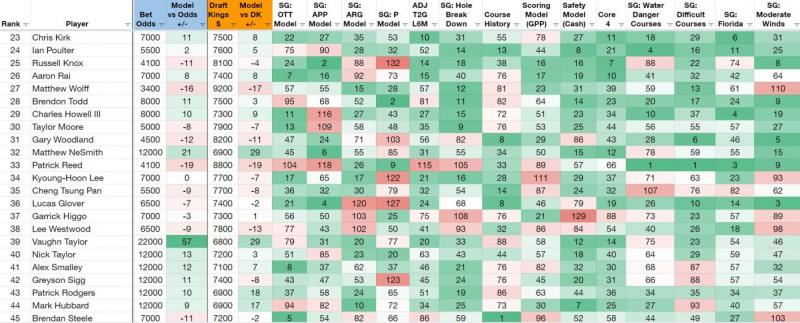
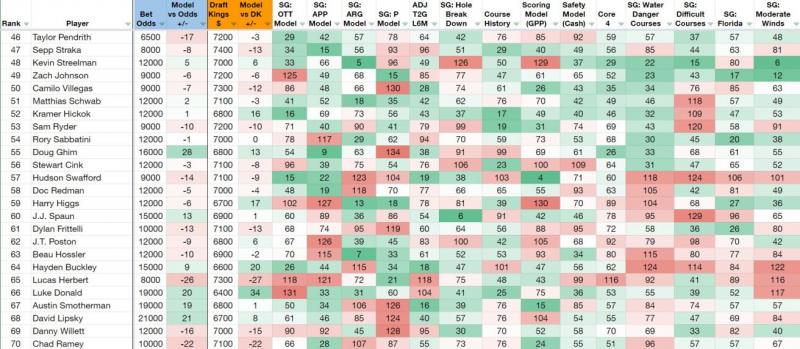
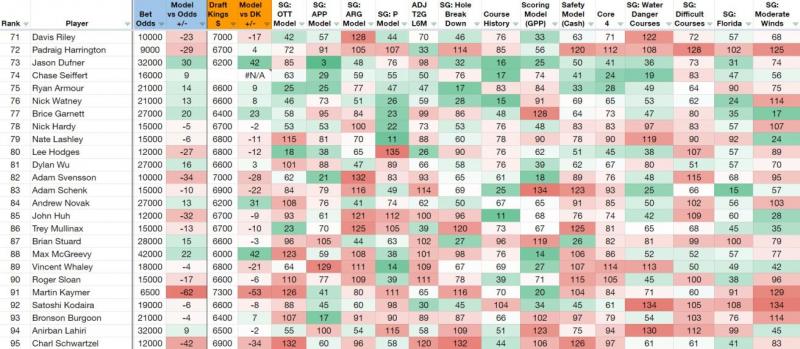
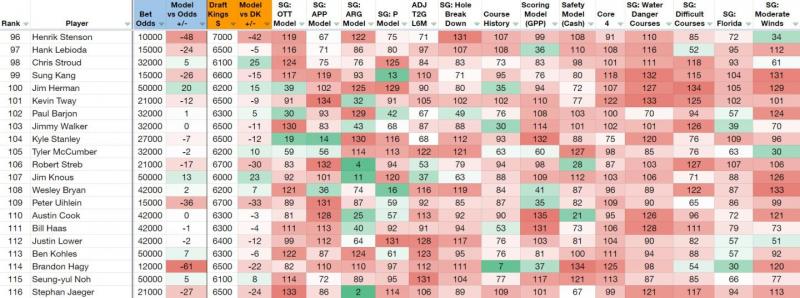
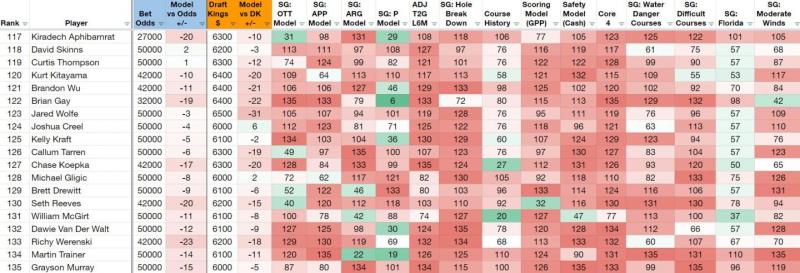
The Honda Classic Final Model
In each preview article and on Discord, I present my final model, which gives a detailed player ranking of the most important stats and splits for the week. My modeling is built around the PGA’s Strokes Gained data, which is divided into SG: Off the Tee (OTT), SG: Approach (APP), SG: Around the Green (ARG) and SG: Putting (P). Learn more about Strokes Gained and why it can be so useful in analyzing the past and predicting future performance. Many of the individual splits will be posted on my Twitter feed, with the final model exclusively published here for subscribers.
Outright Betting Selections
*Lines accurate at the time of publication.
Daniel Berger +1800 (currently +1600)
(1.2u) DraftKings
Having plenty of time to rest and recover from his minor injury, Daniel Berger is the best player in this field. He is first overall in tee-to-green and in the Core 4, which emphasizes the most important stats for this course. He also ranks first in the SG: Wind model as his penetrating low ball flight plays perfectly in the windy conditions typically seen here. He finished fourth here in 2020.
Louis Oosthuizen +2200
(0.91u) PointsBet
Simply put, there is no other player who is more due to win than Louis Oosthuizen. Oosty excels on difficult-scoring courses such as PGA National and is one of the best players in this field. That combination alone should keep him in contention to the end. Ranking fourth in tee-to-green over the past six months and third in the Core 4, he has an all-around game, doesn’t make big mistakes and has the ability to grind out pars that allow for success here.
Keith Mitchell +4000 (currently +3500)
(0.5u) DraftKings
PGA National requires players to be consistent off the tee, which is the facet of Keith Mitchell’s game in which he excels. He ranks sixth overall in the model and has shown no real weaknesses in his game over the past four-plus months with five top-12 finishes. He won here in 2019 and loves playing on Bermuda in Florida.
Matthew Wolff +4500
(0.45u) PointsBet
The perfect “boom or bust” play, Matthew Wolff is the exact type of player who could win by five shots or miss the cut. While the potential is there for him to spray it off the tee and be 6-over par four holes into his round on Thursday, he has the talent and overall game to conquer this challenging course. He ranks 13th in the field on other tough scoring courses, and his only victory at TPC Twin Cities came on a similar “risk-reward” course.
Mito Pereira +5000 (currently +4500)
(0.40u) PointsBet
Mito Pereira checks all the boxes this week and comes at a great price. While he has been trending for a while, his game had recently gotten a bit inconsistent. That changed last week when he gained 3.6 strokes tee to green and two more with the putter. He is one of the best ball-strikers in the field, and if he can stay out of trouble off the tee, he should be in contention come Sunday.
More Outright Selections
- Aaron Wise +6000 (currently +5000), 0.34u PointsBet
- Denny McCarthy +6600 (currently +5500), 0.33u BetRivers
- Cameron Young +6600 (currently +5500), 0.30u BetRivers
- Garrick Higgo +11000, 0.18u BetRivers
- Greyson Sigg +12500 (currently +7000), 0.16u PointsBet
- Hudson Swafford +18000 (currently +10000), 0.11u DraftKings
- Austin Smotherman +28000, (currently +16000) 0.25u PointsBet
Finishing Position Picks
Top 10
Top 20
- Louis Oosthuizen +100, (1.1u) FanDuel
- Daniel Berger +115, (currently -110) (1.1u) FanDuel
- Billy Horschel +140, (1u) FanDuel
Top 30
- Tommy Fleetwood +125, (1.2u) FanDuel
- Keith Mitchell +125, (1.1u) FanDuel
- Brian Harman +140, (1u) FanDuel
- Christiaan Bezuidenhout +155, (1u) FanDuel
Top 40
DraftKings DFS Strategy
As you can probably gather, we should expect much lower point totals this week with our DraftKings lineups. Birdie streaks and bogey-free rounds will be few and far between. Because of this, placement points will have added emphasis. With that in mind, along with a lack of overall “stars”, and the fact the $6,000 range is mostly a pile of hot trash, my strategy this week will be a more balanced approach. Players who have shown past success on other difficult scoring courses with similar water danger will be high on my radar. You also need to expect a lot of variance this week. Even consistent performers could be outside of the cut-line after a couple bad holes.
Even though we want as much balance as possible, I will still try to have one of either Im, Berger or Oosthuizen in as many of my lineups as possible. Each is consistent and among the top-five players in this field.
Also, make sure to pay attention to the weather. The wind forecast can change very quickly, making either the AM or PM wave very advantageous to play if an edge can be found.
Player Selection
Each week this section will contain three main categories. They are my “Core” plays, my “Price Range” plays and my “Biggest Fades”. For those of you new to some of that DFS verbiage, a core play is a golfer I will be including in the majority of my lineups. They will always be among the handful of my overall top plays for the week. A typical core contains anywhere between 2-4 golfers. After you establish your “pool” of players (the group of players you choose from to build your lineups with at different ownership percentages) for the week, you then surround that core by mixing and matching your other players from varying price ranges. A “fade” is a player you are choosing to either be underweight on compared to the field or not play at all. In the player picks below, unless otherwise specified, the numbers next to each of the categories or metrics is their ranking in this field out of 144 total golfers over the past six months. Keep in mind that while there are 144 golfers in the field, numerous players do not have enough data to be included in the model. The “Core 4” most important stats for the event will always be included among the stats chosen. Own % is referring to the estimated amount each player will be owned in the typical DraftKings contest. For this week, the safety model rank is included and is of the utmost importance for this week.
Core Plays
Keith Mitchell
- Price: $9,100
- Own: 22%
- Model: 6
- SG: APP: 30
- Safety: 11
- Scoring: 5
- CH: 36
- Core 4: 9
- Recent Form: 6
- DraftKings Pts Gained: 9
Billy Horschel
- Price: $9,600
- Own: 23%
- Model: 7
- SG: APP: 94
- Safety: 6
- Scoring: 38
- CH: 10
- Recent Form: 7
- Core 4: 18
- DraftKings Pts Gained: 8
Denny McCarthy
- Price: $7,800
- Own: 10%
- Model: 11
- SG: APP: 108
- Safety: 2
- Scoring: 10
- CH: 46
- Recent Form: 1
- Core 4: 27
- DraftKings Pts Gained: 6
Upper-Tier Plays
Daniel Berger
- Price: $10,400
- Own: 18%
- Model: 2
- SG: APP: 10
- Safety: 3
- Scoring: 9
- CH: 6
- Core 4: 1
- Recent Form: 9
- DraftKings Pts Gained: 27
Louis Oosthuizen
- Price: $10,800
- Own: 17%
- Model: 3
- SG: APP: 12
- Safety: 10
- Scoring: 6
- CH: 43
- Core 4: 3
- Recent Form: 17
- DraftKings Pts Gained: 21
Sungjae Im
- Price: $11,000
- Own: 24%
- Model: 1
- SG: APP: 23
- Safety: 1
- Scoring: 11
- CH: 4
- Core 4: 2
- Recent Form: 2
- DraftKings Pts Gained: 7
Mid-Range Plays
Jhonattan Vegas
- Price: $8,500
- Own: 13%
- Model: 9
- SG: APP: 5
- Safety: 38
- Scoring: 22
- CH: 24
- Core 4: 8
- Recent Form: 34
- DraftKings Pts Gained: 29
Christiaan Bezuidenhout
- Price: $8,000
- Own: 11%
- Model: 12
- SG: APP: 8
- Safety: 13
- Scoring: 12
- CH: 76
- Core 4: 6
- Recent Form: 22
- DraftKings Pts Gained: 24
Brian Harman
- Price: $8,700
- Own: 10%
- Model: 16
- SG: APP: 114
- Safety: 4
- Scoring: 66
- CH: 64
- Core 4: 33
- Recent Form: 13
- DraftKings Pts Gained: 25
Value Plays
*In order of preference
- Michael Thompson, $7,500
- Chris Kirk, $7,500
- Ian Poulter, $7,600
- Aaron Rai, $7,400
- KH Lee, $7,700
- Taylor Moore, $7,900
- CT Pan, $7,700
- Garrick Higgo, $7,300
- Mackenzie Hughes, $7,100
- Brendon Todd, $7,500
- Mark Hubbard, $6,900
- Kramer Hickok, $6,800
Biggest Fades
- Brooks Koepka, $10,100
- Matt Jones, $9,000
- Patrick Reed, $8,800
For the most up-to-date picks, or if you have any questions or comments, check out my Twitter and subscribe to our Discord. This sheet from Dan Rivera tracks all my betting picks (and those from the rest of the betting staff) on the year. Just click on the tab with my name on it for the results.
This article is intended for entertainment purposes and adult users only. Call 1-800-GAMBLER if you have a gambling problem.